By Crisna | Portugal
Porto was one of those cities that won us over quickly. In just 48 hours, we managed to walk through historic streets, see some of Portugal’s most famous landmarks, try the local cuisine, cross the Douro River, and dive into the history of Port wine.
With an atmosphere that blends historical heritage, great food, architecture, the river, and a very pleasant urban life, Porto is a destination that perfectly suits those who love to explore a city on foot without a rushed itinerary.
Our visit was short, but enough to understand why Porto deserves a few days on any travel itinerary through Portugal.
What is Porto, Portugal like?
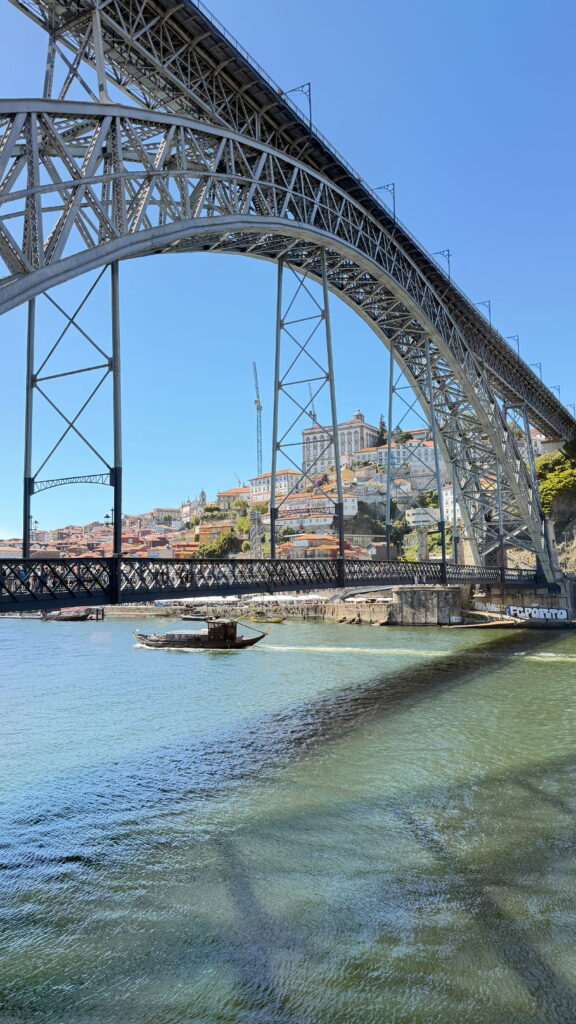
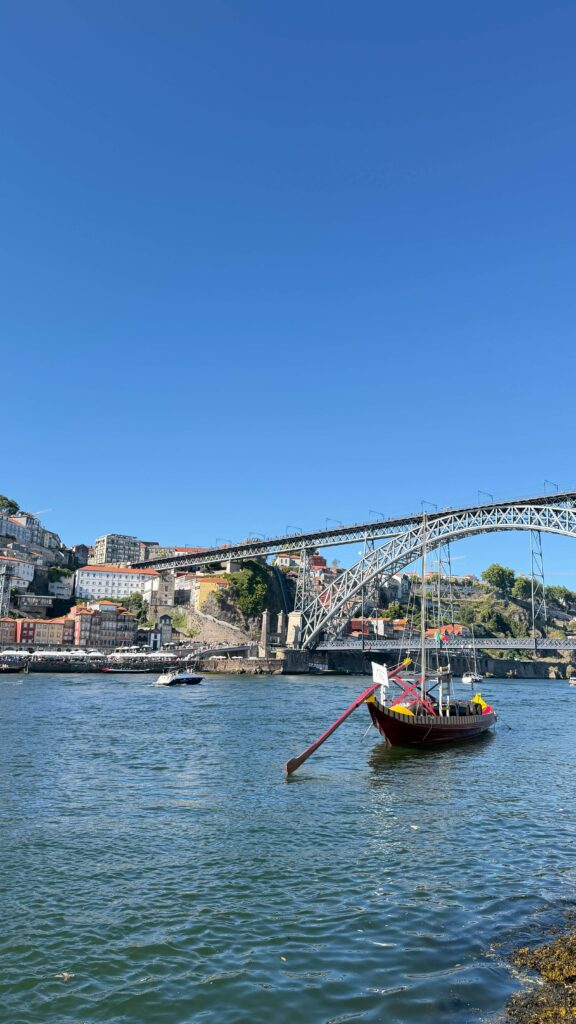
Porto is the second-largest city in Portugal and is located on the banks of the Douro River in the northern part of the country.
It is a historic city, yet it has a young and very lively atmosphere. The downtown area brings together churches, historic buildings, cafes, restaurants, shops, and cobblestone streets, while the Ribeira district offers one of the most beautiful views in the city.
One of the best things about Porto is precisely the ability to explore most of its main tourist attractions on foot.
However, there is an important detail: Porto has many hills, and some walks are quite steep. Because of this, a comfortable pair of shoes makes all the difference.
Our experience was exactly that: we used Uber for a few strategic trips and did most of the itinerary walking.
When to go to Porto?
Porto can be visited year-round, but each season offers a different experience.
Spring — March to May
It is a great time to visit the city, with more pleasant temperatures and days that are starting to get longer.
Summer — June to August
This is the peak tourist season, featuring the longest and warmest days. For those who want to fully enjoy outdoor activities, it can be a good choice, but it is important to consider that July and August usually have the highest demand.
Autumn — September to November
September can be especially interesting: the weather is still pleasant, but the city tends to be less crowded than during the height of summer.
Winter — December to February
Temperatures are lower, and there is a higher chance of rain. On the other hand, it is an interesting time for those who prefer to travel with fewer crowds and potentially find more attractive prices.
LoveTip: If you can choose, spring and early autumn are very interesting periods to explore Porto on foot.
How to get there and get around in Porto?
The Francisco Sá Carneiro Airport is relatively close to the city center.
Upon arrival, we opted for an Uber from the airport to our accommodation, which is a practical alternative, especially when you have luggage.
Afterward, to see the main tourist spots, we did a lot of things on foot.
For us, this was one of the best ways to experience Porto: walking without rushing, observing the architecture, stepping into smaller streets, and discovering places along the way.
Public transportation is also an option for those who prefer to avoid the hills or need to travel longer distances.
LoveTip: Do not plan your itinerary based solely on distances on the map. In Porto, a walk of just a few kilometers can involve quite a bit of uphill and downhill walking.
Where to stay in Porto?
During our time in the city, we had two different accommodation experiences.
YOTEL Porto
Our first base was YOTEL Porto, a modern, comfortable accommodation very well located for anyone wanting to explore the city.
The location was one of the main factors that made our experience easier, as we could walk to several spots downtown.
It is an interesting option for those looking for a contemporary concept and convenience during a short trip.
Vila Galé Porto
We also stayed at Vila Galé Porto, another alternative for those seeking full hotel amenities.
Having two different bases also allowed us to experience distinct areas and styles of accommodation in the city.
LoveTip: For a first trip, and especially for a short stay, prioritize location. Being well-positioned can make a significant difference in Porto.
Porto in 48 Hours: Our Itinerary
If you only have two days in the city, it is possible to put together a very complete itinerary without having to rush.
DAY 1 — Avenida dos Aliados, São Bento, Ribeira, and the Douro
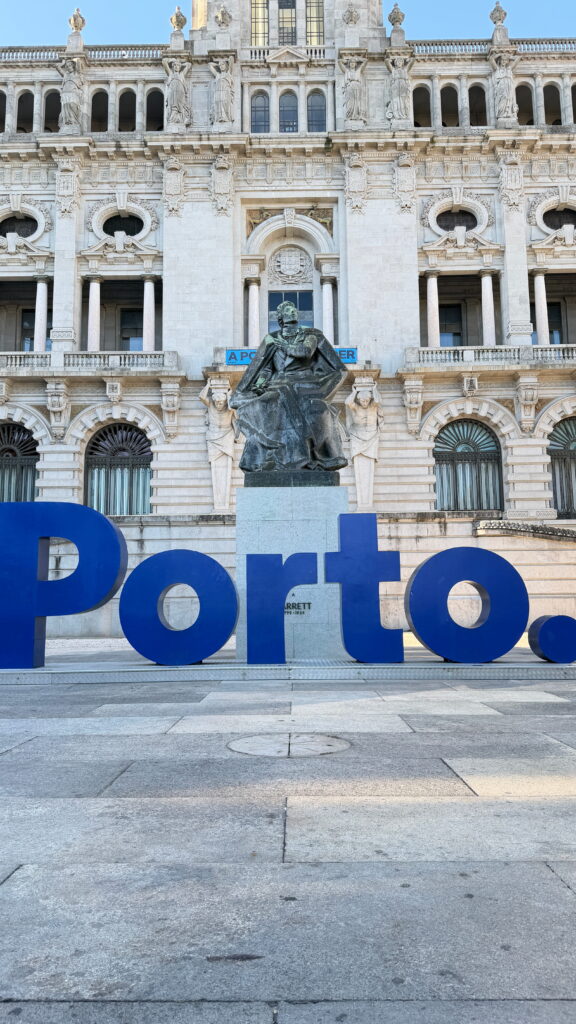
We started our first day at Avenida dos Aliados, one of the most iconic areas in central Porto.
The region is characterized by historic buildings and the imposing City Hall building.
From there, we walked over to the São Bento Train Station.
São Bento Train Station
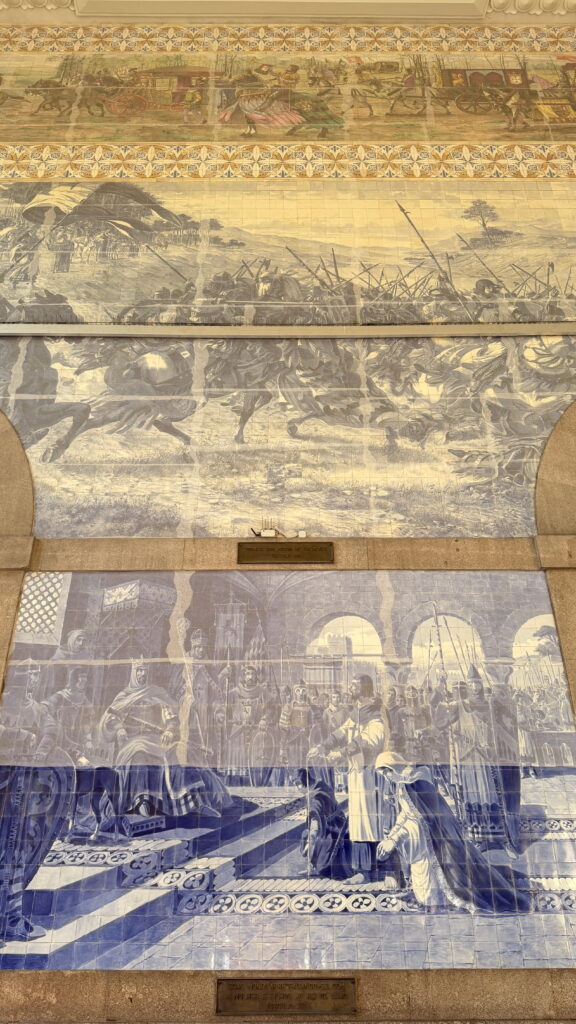
Even if you do not need to catch a train, it is worth stepping inside the station.
The main highlight is the central lobby, decorated with thousands of azulejos (ceramic tiles) depicting episodes from Portugal’s history.
It is a quick but absolutely unmissable stop.
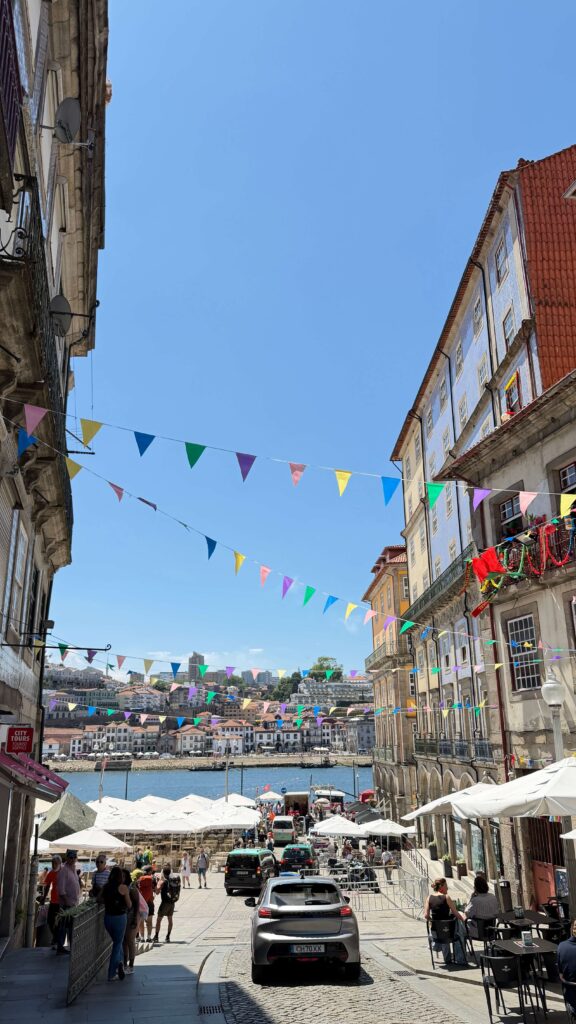
Afterward, we continued through the streets of the historic center toward Ribeira.
Ribeira do Porto
Ribeira is probably one of the images most associated with the city.
The colorful facades, the Douro River, the boats, and the Dom Luís I Bridge form a scenery that deserves to be admired without rush.
Our suggestion is to set aside some time simply to walk along the pier and observe the city.
Dom Luís I Bridge
The bridge is one of Porto’s great landmarks.
Built in the 19th century, it connects Porto to Vila Nova de Gaia and features two levels of traffic.
The view from the top is especially beautiful and yields some of the best photographs of the trip.
Dinner at Borboleta
To wrap up our first day, we had dinner at Borboleta, a delightful culinary surprise.
The menu combines creativity with Portuguese ingredients, making every dish a true discovery.
For us, it was a wonderful way to end our first day in the city.
DAY 2 — Lello Bookstore, Clérigos, Rua das Flores, and Vila Nova de Gaia
The second day began with some of Porto’s most famous tourist attractions.
Lello Bookstore (Livraria Lello)
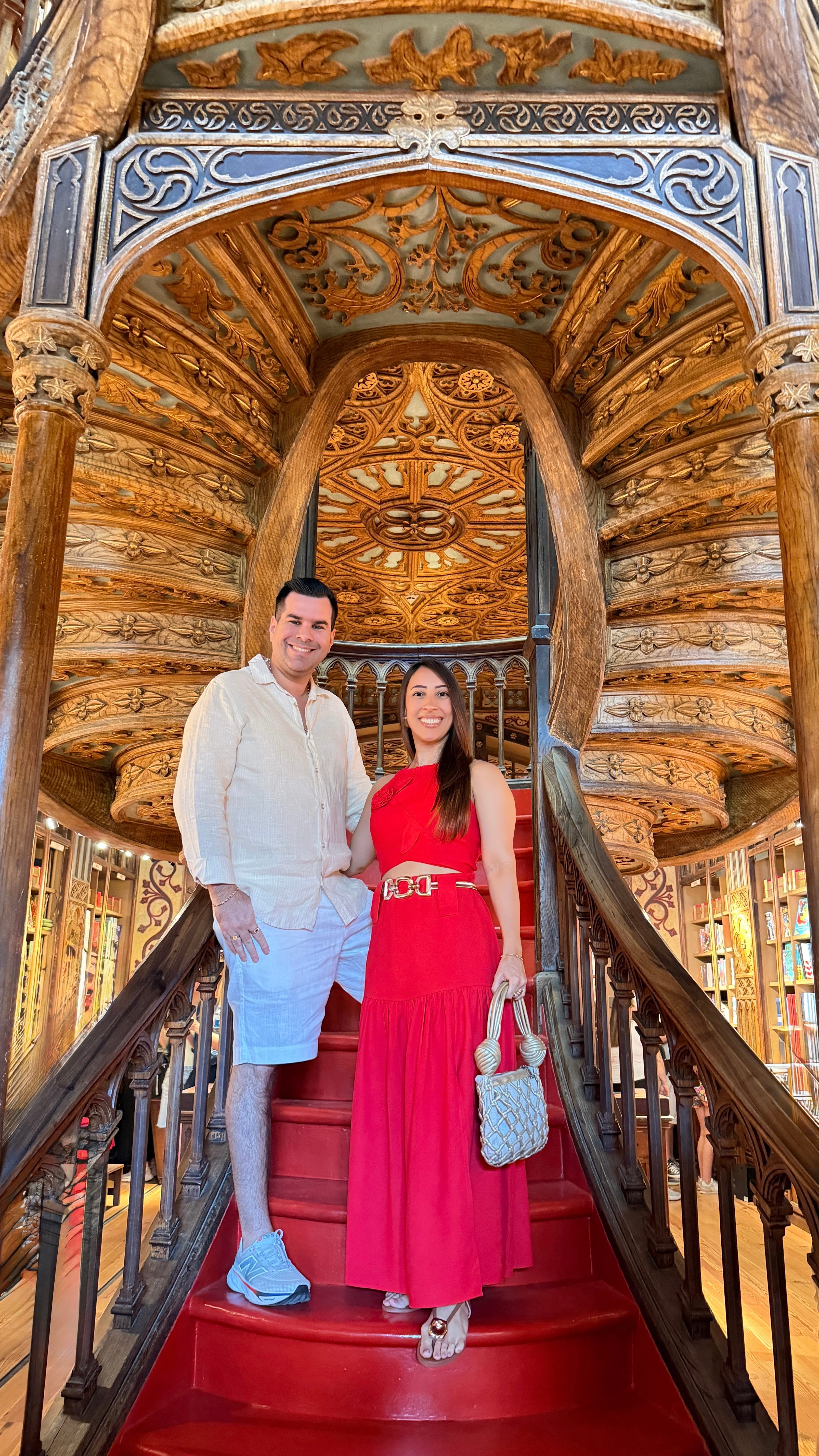
Lello Bookstore is one of the most popular attractions in the city, so we highly recommend buying your ticket in advance through the official website.
The bookstore became famous mainly for its architecture, featuring a striking central staircase and a richly detailed interior.
Even if you are not passionate about books, the space is well worth visiting.
LoveTip: Schedule your visit time and buy your ticket in advance, especially during peak seasons.
Conversa no Modo IA: gemini
Você disse: gemini
gemini
13:35
Resultados rápidos da Web:
Google Gemini
Conheça o Gemini, o assistente de IA do Google. Receba ajuda para escrever, planejar, ter ideias e muito mais. Conheça o poder da IA generativa.

Google·https://gemini.google.com
Gemini: seu assistente de IA do Google
Turbine sua criatividade e produtividade com o assistente de IA do Google. Troque ideias, esclareça os assuntos mais complicados e até mesmo ensaie para apresentações importantes.

Google Gemini·https://gemini.google
O Google Gemini é a família de modelos de inteligência artificial generativa e o assistente pessoal desenvolvidos pelo Google. Criado originalmente para competir com o ChatGPT, ele evoluiu para um ecossistema multimodal integrado, capaz de processar simultaneamente textos, códigos, imagens, áudios e vídeos. [1, 2, 3]
O ecossistema divide-se principalmente em recursos focados em produtividade, automação com agentes e planos sob medida para diferentes perfis:
Planos e Acesso para Usuários
- Gratuito (Acesso Geral): Disponível via web ou aplicativo móvel. Permite interações de texto, voz e análise de arquivos básicos. [1, 2, 3]
- Plano Estudante (Oferta Gratuita por 1 Ano): Estudantes de 18 a 24 anos têm acesso gratuito ao plano AI Plus por 12 meses. O benefício inclui 400 GB de armazenamento no Google Drive, uso do Gemini Live para conversas em tempo real por áudio, e geração de vídeos com o modelo Gemini OMN. O resgate pode ser feito diretamente na página para estudantes do Gemini. [1, 2]
- Upgrade Ultra (Planos Pagos): Dá acesso aos modelos mais avançados (como o 3.1 Pro), ferramentas de pesquisa profunda (Deep Research), geração de vídeos via Veo 3.1, integração direta nos aplicativos do Google Workspace (Gmail, Documentos) e armazenamento em nuvem expandido a partir de 20 TB. [1]
Tecnologias e Recursos de Destaque
- Modo Agente e Gemini Spark: Nova capacidade focada em automação independente. O Gemini Spark atua como um agente pessoal que divide grandes metas em etapas menores, gerencia planilhas conectadas ao YouTube, lê e extrai dados do Gmail e cria rascunhos de forma autônoma em segundo plano através de navegadores persistentes na nuvem. [1, 2, 3]
- Variantes Técnicas (Modelos 3.8): A linha de modelos rápidos conta com o Gemini 3.8 Flash. O Google também desenvolveu o 3.8 Flash Cyber, uma variante fechada e estritamente focada em segurança cibernética e análise profunda de códigos para ambientes corporativos e governamentais. [1]
Se você quiser saber mais sobre como utilizar a IA, me conte: qual é o seu objetivo principal com o Gemini (estudos, automação de trabalho, desenvolvimento de código)? Posso te guiar no passo a passo para configurar os melhores recursos. [1, 2, 3]
Google GeminiGemini: seu assistente de IA do GoogleSeu agente pessoal. O Gemini Spark é seu agente pessoal de IA. Divida grandes metas em etapas menores e conecte seus apps favorito…
Google GeminiGoogle AI Pro e Ultra: acesse o Gemini 3.1 Pro e muito maisFaça upgrade para o plano Ultra e aproveite o melhor do Gemini. Tenha acesso máximo aos nossos recursos mais avançados, como geraç…
YouTube·InvestNews BRGemini Spark: o agente de IA ideal para tarefas no ecossistema GoogleGemini Spark: o agente de IA ideal para tarefas no ecossistema Google aqui vai um exemplo de um prompt que não funcionaria até pou…
5:19
Mostrar tudo
Você enviou: 2 imagens e disse: Vamos la … para o Instagram @love.travelers fazer um reels de ate 30 segundos com a JetSMART seguir o briefing. O destino será Buenos Aires
Vamos la … para o Instagram @love.travelers fazer um reels de ate 30 segundos com a JetSMART seguir o briefing. O destino será Buenos Aires
13:36
Aqui está um roteiro completo de Reels estruturado exatamente com base nas regras do briefing da JetSMART – Semana do Cliente, adaptado para o perfil @love.travelers com foco em Buenos Aires:
🎬 Estrutura do Reels: “A escapada perfeita para Buenos Aires”
- Duração: Até 30 segundos
- Formato: Vertical (9:16)
- Estilo: Dinâmico, inspirador, com tomadas reais e transições rápidas. Evitar o influenciador falando parado para a câmera.
📝 Roteiro Técnico e de Áudio
| Tempo | Visual (O que mostrar) | Áudio (Locução / Texto Falado) | Texto na Tela (Sobreimpressão) |
|---|---|---|---|
| 00:00 – 00:05 | [GANCHO] Clipe rápido pegando o passaporte, seguido por uma transição rápida de você entrando no avião da JetSMART ou caminhando pelas ruas de Buenos Aires. | “Sabe aquela escapada tranquila que você estava esperando? Ela tá te chamando bem aqui.” | A escapada que você estava esperando ✈️🇦🇷 |
| 00:05 – 00:15 | [DESENVOLVIMENTO] Cortes rápidos e estéticos: show de tango à noite, um bom corte de carne (parrilla), o colorido do Caminito e cafés charmosos na Recoleta. | (Apenas música instrumental animada/aspiracional de fundo, sem locução) | Cultura, tango e boa mesa: Buenos Aires pede uma viagem! |
| 00:15 – 00:25 | Janela do avião voando e você curtindo o destino. | (Música continua) | Aproveite a Semana Do Cliente para conhecer Buenos Aires ✈️ [Em destaque menor no canto]: Preços sujeitos a alterações. |
| 00:25 – 00:30 | [FECHAMENTO / CTA] Tela final com o logo da JetSMART (com contêiner branco) ou a logo do perfil com o avião ao fundo. | “Aproveite a Semana Do Cliente da JetSMART e planeje sua próxima viagem hoje mesmo.” | Semana Do Cliente JetSMART De 14 a 20 de setembro 🚀 |
⚠️ Regras do Briefing Aplicadas (Double-Check)
- Atenção aos Preços: ⛔ Não foram ditos preços nem percentuais na locução. O aviso de que as tarifas podem mudar foi colocado estritamente em sobreimpressão de texto.
- Identidade Visual: A marca foi escrita exatamente como JetSMART (com SMART em maiúsculas).
- Dinâmica do Conteúdo: Sem “talking head” (influenciador parado falando com a câmera). Foco total em tomadas reais e inspiradoras do destino para despertar a vontade de viajar.
Porto em 48 horas: um roteiro pela cidade que nos conquistou Por Crisna | Portugal Porto foi uma daquelas cidades que nos conquistaram rapidamente. Em apenas 48 horas, conseguimos caminhar por ruas históricas, conhecer alguns dos cartões-postais mais famosos de Portugal, experimentar a gastronomia local, atravessar o Douro e ainda mergulhar na história do vinho do Porto. Com uma atmosfera que mistura patrimônio histórico, boa gastronomia, arquitetura, rio e uma vida urbana bastante agradável, Porto é um destino que combina muito com quem gosta de explorar uma cidade caminhando, sem precisar de um roteiro corrido. Nossa passagem foi curta, mas suficiente para entender por que Porto merece alguns dias no roteiro de uma viagem por Portugal. Foto Como é Porto, em Portugal? Porto é a segunda maior cidade de Portugal e está localizada às margens do Rio Douro, no norte do país. É uma cidade histórica, mas que ao mesmo tempo tem uma atmosfera jovem e bastante viva. O centro reúne igrejas, edifícios históricos, cafés, restaurantes, lojas e ruas de pedra, enquanto a região da Ribeira oferece uma das paisagens mais bonitas da cidade. Uma das melhores características de Porto é justamente a possibilidade de conhecer grande parte de seus principais pontos turísticos a pé. Mas há um detalhe importante: Porto tem muitas ladeiras e algumas caminhadas são bastante íngremes. Por isso, um calçado confortável faz toda a diferença. Nossa experiência foi justamente essa: usamos Uber para alguns deslocamentos mais estratégicos e fizemos boa parte do roteiro caminhando. Quando ir para Porto? Porto pode ser visitada durante todo o ano, mas cada estação oferece uma experiência diferente. Primavera — março a maio É uma ótima época para conhecer a cidade, com temperaturas mais agradáveis e dias que começam a ficar mais longos. Verão — junho a agosto É a época de maior movimento turístico e também de dias mais longos e quentes. Para quem quer aproveitar bastante os passeios ao ar livre, pode ser uma boa escolha, mas é importante considerar que julho e agosto costumam ter maior procura. Outono — setembro a novembro Setembro pode ser especialmente interessante: ainda há dias agradáveis, mas a cidade tende a ficar menos movimentada do que no auge do verão. Inverno — dezembro a fevereiro As temperaturas são mais baixas e há maior possibilidade de chuva. Por outro lado, é uma época interessante para quem prefere viajar com menos movimento e encontrar preços potencialmente mais atrativos. Lovedica: se você puder escolher, primavera e início do outono são períodos muito interessantes para explorar Porto caminhando. Como chegar e como se locomover em Porto? O Aeroporto Francisco Sá Carneiro fica relativamente próximo do centro da cidade. Na nossa chegada, optamos pelo Uber do aeroporto até a hospedagem, uma alternativa prática principalmente quando se está com malas. Depois, para conhecer os principais pontos turísticos, fizemos muita coisa a pé. Para nós, essa foi uma das melhores formas de conhecer Porto: caminhar sem pressa, observar a arquitetura, entrar nas ruas menores e descobrir lugares pelo caminho. O transporte público também é uma opção para quem prefere evitar as ladeiras ou precisa percorrer distâncias maiores. Lovedica: não monte um roteiro baseado apenas em distâncias no mapa. Em Porto, uma caminhada de poucos quilômetros pode envolver bastante subida e descida. Onde ficar em Porto? Durante nossa passagem pela cidade, tivemos duas experiências de hospedagem. YOTEL Porto Nossa primeira base foi o YOTEL Porto, uma hospedagem moderna, confortável e muito bem localizada para quem quer explorar a cidade. A localização foi um dos pontos que mais facilitaram nossa experiência, já que conseguimos sair caminhando para diversos pontos do centro. É uma opção interessante para quem procura uma proposta contemporânea e quer ter praticidade durante uma viagem curta. Vila Galé Porto Também ficamos no Vila Galé Porto, outra alternativa para quem busca estrutura hoteleira completa. Ter duas bases diferentes também nos permitiu experimentar regiões e propostas distintas de hospedagem na cidade. Lovedica: para uma primeira viagem e especialmente para uma estadia curta, priorize localização. Estar bem posicionado pode fazer bastante diferença em Porto. Porto em 48 horas: nosso roteiro Se você tem apenas dois dias na cidade, é possível montar um roteiro bastante completo sem precisar correr. DIA 1 — Avenida dos Aliados, São Bento, Ribeira e Douro Começamos nosso primeiro dia pela Avenida dos Aliados, uma das áreas mais emblemáticas do centro do Porto. A região é marcada por edifícios históricos e pelo imponente edifício da Câmara Municipal. De lá, seguimos caminhando até a Estação de São Bento. Foto Estação de São Bento Mesmo que você não precise pegar um trem, vale entrar na estação. O grande destaque está no saguão principal, decorado com milhares de azulejos que representam episódios da história de Portugal. É uma parada rápida, mas absolutamente imperdível. Depois, seguimos pelas ruas do centro histórico em direção à Ribeira. Ribeira do Porto A Ribeira é provavelmente uma das imagens mais associadas à cidade. As fachadas coloridas, o Rio Douro, os barcos e a Ponte Dom Luís I formam um cenário que merece ser contemplado sem pressa. Nossa sugestão é reservar um tempo simplesmente para caminhar pelo cais e observar a cidade. Ponte Dom Luís I A ponte é um dos grandes cartões-postais de Porto. Construída no século XIX, ela conecta Porto a Vila Nova de Gaia e possui dois níveis de circulação. A paisagem do alto é especialmente bonita e rende algumas das melhores fotografias da viagem. Jantar no Borboleta Para encerrar nosso primeiro dia, jantamos no Borboleta, uma grata surpresa gastronômica. A proposta combina criatividade e ingredientes portugueses, e cada prato acabou sendo uma descoberta. Para nós, foi uma ótima maneira de terminar o primeiro dia na cidade. DIA 2 — Livraria Lello, Clérigos, Rua das Flores e Vila Nova de Gaia O segundo dia começou com alguns dos pontos turísticos mais famosos de Porto. Livraria Lello A Livraria Lello é uma das atrações mais procuradas da cidade e, por isso, nossa recomendação é comprar o ingresso antecipadamente pelo site oficial. A livraria ficou famosa principalmente por sua arquitetura, com destaque para a escadaria central e o interior ricamente trabalhado. Mesmo para quem não é apaixonado por livros, vale conhecer o espaço. Lovedica: programe o horário da visita e compre o ingresso antecipadamente, principalmente em períodos de maior movimento. Torre dos Clérigos Depois, seguimos para a Torre dos Clérigos, outro dos símbolos de Porto. A torre faz parte da Igreja dos Clérigos e oferece uma vista panorâmica da cidade. São muitos degraus até o topo, mas a vista compensa para quem gosta de mirantes. Rua das Flores e Centro Histórico Depois dos pontos turísticos, vale simplesmente caminhar. A Rua das Flores é uma das ruas mais charmosas do centro e conecta diferentes áreas históricas da cidade. Essa é uma das partes do roteiro em que recomendamos não ter pressa. Entre uma atração e outra, pare para observar as fachadas, os detalhes dos prédios, pequenas lojas e cafés. Almoço no Brasão Cervejaria Para o almoço, escolhemos o tradicional Brasão Cervejaria. É uma boa parada para experimentar pratos típicos e petiscos portugueses em um ambiente descontraído. Vila Nova de Gaia: atravesse o Douro e reserve algumas horas Depois do almoço, atravessamos o Rio Douro em direção a Vila Nova de Gaia. E aqui fica uma das nossas principais recomendações para quem visita Porto: não deixe Gaia de fora do roteiro. Embora muitas vezes seja tratada como uma extensão de Porto, a margem de Gaia tem uma experiência própria e é justamente onde estão algumas das caves mais tradicionais de vinho do Porto. Foto Cais de Gaia Comece caminhando pelo cais. Do outro lado do rio, você terá uma das melhores perspectivas para observar a Ribeira do Porto e a Ponte Dom Luís I. O cenário fica ainda mais bonito no final da tarde, quando a luz começa a mudar. Visita a uma cave de vinho do Porto Uma das experiências
traduza para ingles
Aqui está a tradução do seu texto para o inglês, mantendo o tom pessoal, fluido e organizado do relato original:
Porto in 48 Hours: A Itinerary Through the City That Won Us Over
By Crisna | Portugal
Porto was one of those cities that won us over quickly. In just 48 hours, we managed to walk through historic streets, see some of Portugal’s most famous landmarks, try the local cuisine, cross the Douro River, and dive into the history of Port wine.
With an atmosphere that blends historical heritage, great food, architecture, the river, and a very pleasant urban life, Porto is a destination that perfectly suits those who love to explore a city on foot without a rushed itinerary.
Our visit was short, but enough to understand why Porto deserves a few days on any travel itinerary through Portugal.
Photo
What is Porto, Portugal like?
Porto is the second-largest city in Portugal and is located on the banks of the Douro River in the northern part of the country.
It is a historic city, yet it has a young and very lively atmosphere. The downtown area brings together churches, historic buildings, cafes, restaurants, shops, and cobblestone streets, while the Ribeira district offers one of the most beautiful views in the city.
One of the best things about Porto is precisely the ability to explore most of its main tourist attractions on foot.
However, there is an important detail: Porto has many hills, and some walks are quite steep. Because of this, a comfortable pair of shoes makes all the difference.
Our experience was exactly that: we used Uber for a few strategic trips and did most of the itinerary walking.
When to go to Porto?
Porto can be visited year-round, but each season offers a different experience.
Spring — March to May
It is a great time to visit the city, with more pleasant temperatures and days that are starting to get longer.
Summer — June to August
This is the peak tourist season, featuring the longest and warmest days. For those who want to fully enjoy outdoor activities, it can be a good choice, but it is important to consider that July and August usually have the highest demand.
Autumn — September to November
September can be especially interesting: the weather is still pleasant, but the city tends to be less crowded than during the height of summer.
Winter — December to February
Temperatures are lower, and there is a higher chance of rain. On the other hand, it is an interesting time for those who prefer to travel with fewer crowds and potentially find more attractive prices.
LoveTip: If you can choose, spring and early autumn are very interesting periods to explore Porto on foot.
How to get there and get around in Porto?
The Francisco Sá Carneiro Airport is relatively close to the city center.
Upon arrival, we opted for an Uber from the airport to our accommodation, which is a practical alternative, especially when you have luggage.
Afterward, to see the main tourist spots, we did a lot of things on foot.
For us, this was one of the best ways to experience Porto: walking without rushing, observing the architecture, stepping into smaller streets, and discovering places along the way.
Public transportation is also an option for those who prefer to avoid the hills or need to travel longer distances.
LoveTip: Do not plan your itinerary based solely on distances on the map. In Porto, a walk of just a few kilometers can involve quite a bit of uphill and downhill walking.
Where to stay in Porto?
During our time in the city, we had two different accommodation experiences.
YOTEL Porto
Our first base was YOTEL Porto, a modern, comfortable accommodation very well located for anyone wanting to explore the city. The location was one of the main factors that made our experience easier, as we could walk to several spots downtown. It is an interesting option for those looking for a contemporary concept and convenience during a short trip.
Vila Galé Porto
We also stayed at Vila Galé Porto, another alternative for those seeking full hotel amenities. Having two different bases also allowed us to experience distinct areas and styles of accommodation in the city.
LoveTip: For a first trip, and especially for a short stay, prioritize location. Being well-positioned can make a significant difference in Porto.
Porto in 48 Hours: Our Itinerary
If you only have two days in the city, it is possible to put together a very complete itinerary without having to rush.
DAY 1 — Avenida dos Aliados, São Bento, Ribeira, and the Douro
We started our first day at Avenida dos Aliados, one of the most iconic areas in central Porto. The region is characterized by historic buildings and the imposing City Hall building. From there, we walked over to the São Bento Train Station.
Photo
São Bento Train Station
Even if you do not need to catch a train, it is worth stepping inside the station. The main highlight is the central lobby, decorated with thousands of azulejos (ceramic tiles) depicting episodes from Portugal’s history. It is a quick but absolutely unmissable stop.
Afterward, we continued through the streets of the historic center toward Ribeira.
Ribeira do Porto
Ribeira is probably one of the images most associated with the city. The colorful facades, the Douro River, the boats, and the Dom Luís I Bridge form a scenery that deserves to be admired without rush. Our suggestion is to set aside some time simply to walk along the pier and observe the city.
Dom Luís I Bridge
The bridge is one of Porto’s great landmarks. Built in the 19th century, it connects Porto to Vila Nova de Gaia and features two levels of traffic. The view from the top is especially beautiful and yields some of the best photographs of the trip.
Dinner at Borboleta
To wrap up our first day, we had dinner at Borboleta, a delightful culinary surprise. The menu combines creativity with Portuguese ingredients, making every dish a true discovery. For us, it was a wonderful way to end our first day in the city.
DAY 2 — Lello Bookstore, Clérigos, Rua das Flores, and Vila Nova de Gaia
The second day began with some of Porto’s most famous tourist attractions.
Lello Bookstore (Livraria Lello)
Lello Bookstore is one of the most popular attractions in the city, so we highly recommend buying your ticket in advance through the official website. The bookstore became famous mainly for its architecture, featuring a striking central staircase and a richly detailed interior. Even if you are not passionate about books, the space is well worth visiting.
LoveTip: Schedule your visit time and buy your ticket in advance, especially during peak seasons.
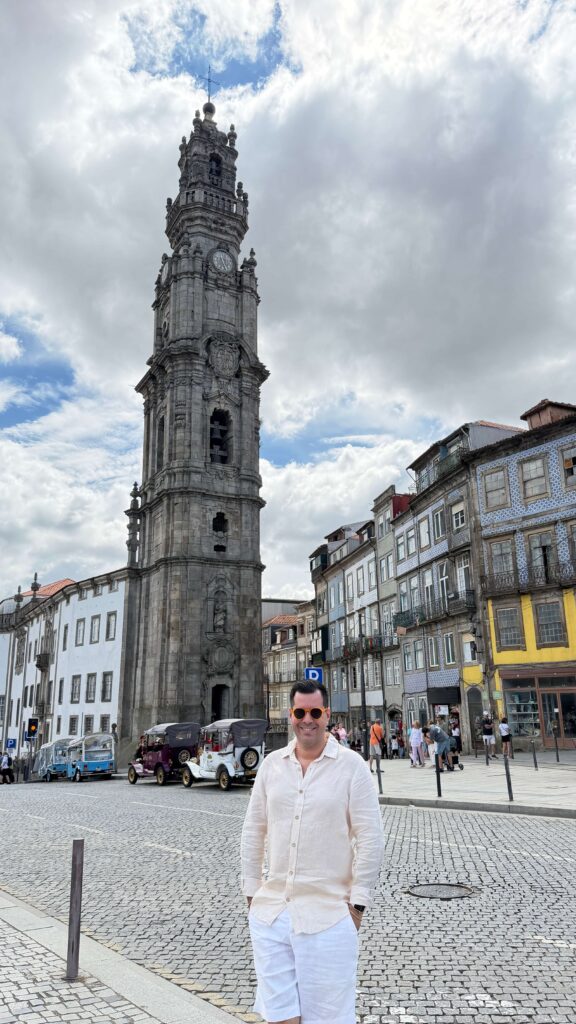
Clérigos Tower (Torre dos Clérigos)
Next, we headed to the Clérigos Tower, another symbol of Porto.
The tower is part of the Clérigos Church and offers a panoramic view of the city.
There are many steps to the top, but the view is rewarding for those who enjoy viewpoints.
Rua das Flores and the Historic Center
After visiting the main landmarks, it is worth just walking around.
Rua das Flores is one of the most charming streets downtown and connects different historic areas.
This is a part of the itinerary where we recommend taking your time. Between one attraction and another, stop to look at the facades, the details of the buildings, small shops, and cafes.
Lunch at Brasão Cervejaria
For lunch, we chose the traditional Brasão Cervejaria.
It is a great stop to try typical dishes and Portuguese snacks in a relaxed atmosphere.
Vila Nova de Gaia: Cross the Douro and set aside a few hours
After lunch, we crossed the Douro River toward Vila Nova de Gaia.
And here is one of our main recommendations for anyone visiting Porto:
do not leave Gaia out of your itinerary.
Although it is often treated as an extension of Porto, the Gaia side offers an experience of its own and is precisely where some of the most traditional Port wine cellars are located.
Gaia Pier (Cais de Gaia)
Start by walking along the pier.
From the other side of the river, you will have one of the best perspectives to look at Ribeira do Porto and the Dom Luís I Bridge.
The scenery gets even more beautiful in the late afternoon, as the light begins to change.
Visiting a Port Wine Cellar
One of the experiences we consider essential is visiting one of the traditional cellars.
We chose Burmester, where we took a guided tour followed by a tasting.

Why do a Port wine tasting?
Because Port wine is part of the region’s very history.
During the cellar tour, you can better understand how the wine is produced, its connection to the Douro Valley, and the aging process.
The tasting also helps you notice the differences between the various styles of Port wine.
For anyone who has never had this kind of experience, it is highly worth it.
LoveTip: Book in advance and, if possible, choose a time in the mid-to-late afternoon to combine the cellar visit with a stroll around Gaia.
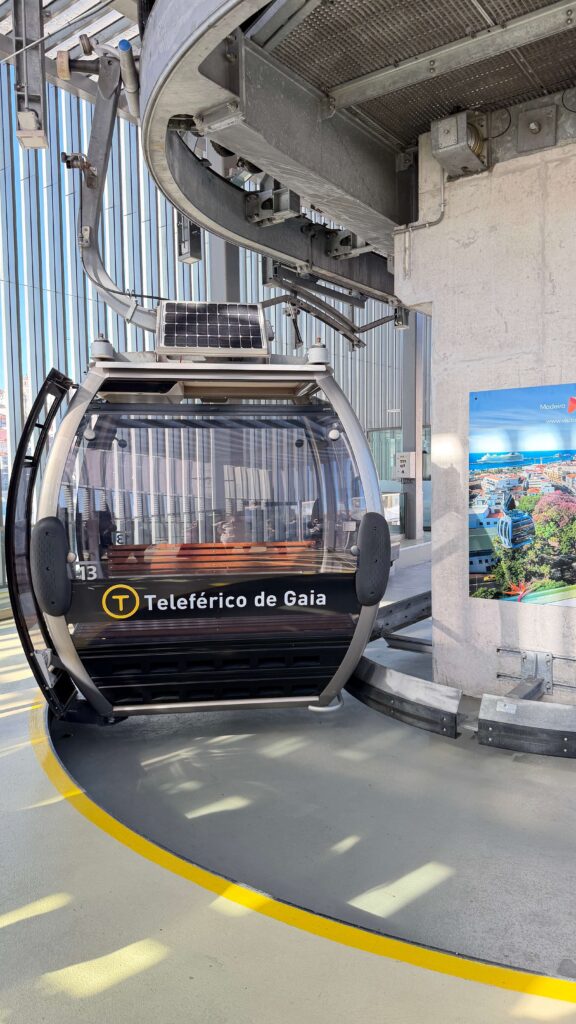
Gaia Cable Car
After the cellar, we headed to the Gaia cable car.
The ride is relatively short, but it provides a privileged view of the Douro River, the Dom Luís I Bridge, and both riverbanks.
It is also a practical way to beat part of Gaia’s uphill climb. And if you can fit this ride into the late afternoon, even better.
We experienced an unforgettable golden hour on the banks of the Douro.
It was one of those moments when the itinerary stops being just a sequence of attractions and turns into a travel memory.
What to eat in Porto?
Porto deserves a special place on your menu.
Portuguese gastronomy is one of the great highlights of the trip, and the city offers everything from contemporary restaurants to traditional spots.
Among the dishes and experiences worth looking for are:
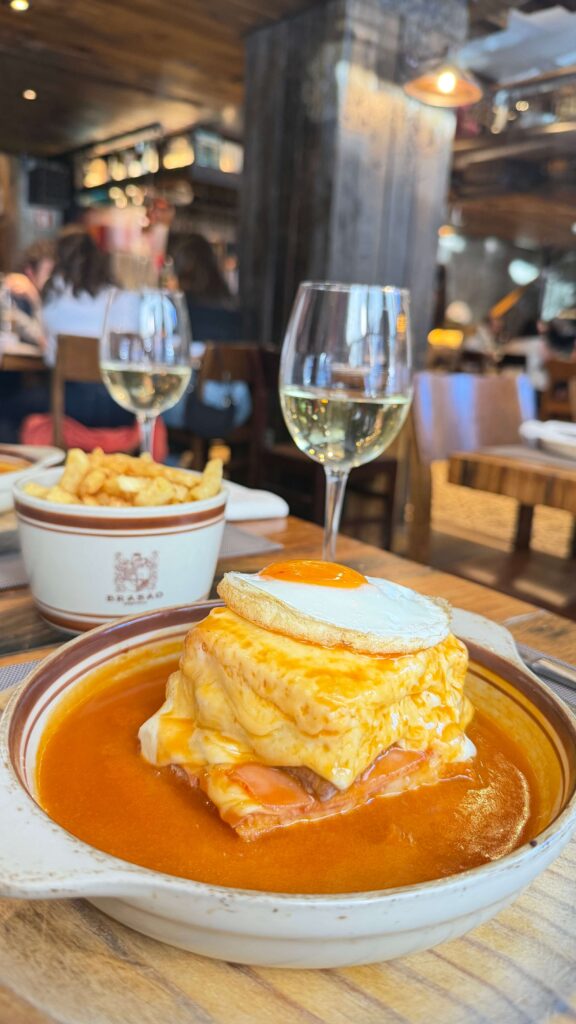
- Francesinha (the city’s signature sandwich)
- Bacalhau (salted codfish)
- Tripas à moda do Porto (traditional tripe stew)
- Bolinhos de bacalhau (codfish croquettes)
- Pastéis de nata (custard tarts)
- Portuguese cheeses and charcuterie
- Portuguese wines
- Port wine
And, of course, set aside some time to explore the Port wine cellars in Vila Nova de Gaia.
More than simply drinking wine, the experience helps you understand the history and identity of the region.
Porto is a city for walking
If we had to pick the single feature that most defined our experience, it would be this:
Porto is a city to be discovered on foot.
Of course, Ubers, the metro, and other means of transportation can make specific trips easier—especially when you have luggage or when the hill is just too steep. However, walking is where you find most of the city’s charm.
An old door, a tiled facade, a small square, a hidden shop, or a cozy cafe might just end up being part of your best memories.
How long to stay in Porto?
48 hours are enough to see the main highlights, especially if you organize your itinerary well.
However, if you have the availability, we recommend 3 days or more.
With more time, you can experience Porto at a slower pace and include experiences such as:
- Palácio da Bolsa (Stock Exchange Palace)
- São Francisco Church
- Bolhão Market
- Casa da Música
- Foz do Douro (where the river meets the ocean)
- Crystal Palace Gardens
- More Port wine cellars
- A boat cruise on the Douro River
- A day trip to the Douro Valley
Is Porto worth it?
Absolutely.
Porto has that perfect combination that makes a trip special:
history, architecture, gastronomy, wine, landscapes, and an atmosphere that invites you to walk around.
In two days, we visited some of the city’s most iconic places, crossed the Douro, toured a traditional cellar, tried the local cuisine, and still managed to enjoy the destination without turning the trip into a race against the clock.
It was only 48 hours, but enough for us to realize that Porto is one of those cities that leaves you wanting to come back.
Porto, 48 hours that won us over.
Itinerary Summary — Porto in 48 Hours
DAY 1
Avenida dos Aliados → São Bento Station → Historic Center → Ribeira → Dom Luís I Bridge → Dinner.
DAY 2
Lello Bookstore → Clérigos Tower → Rua das Flores → Historic Center → Lunch → Vila Nova de Gaia → Gaia Pier → Port Wine Cellar + Tasting → Cable Car → Sunset on the banks of the Douro.
LoveTip: If you can add a third day, use it to visit attractions that were left out and, above all, to explore the city without rushing. After all, Porto deserves to be lived beyond the postcards.